Enterprise Resource Planning (ERP) software continues to evolve as businesses demand smarter automation, better collaboration, and data-driven decision-making. Odoo has consistently introduced new capabilities with each release, making it one of the most popular open-source ERP platforms for organizations of all sizes. As anticipation builds around the next major release, many business leaders are asking:
What's new in Odoo 20, and should you plan for an upgrade?
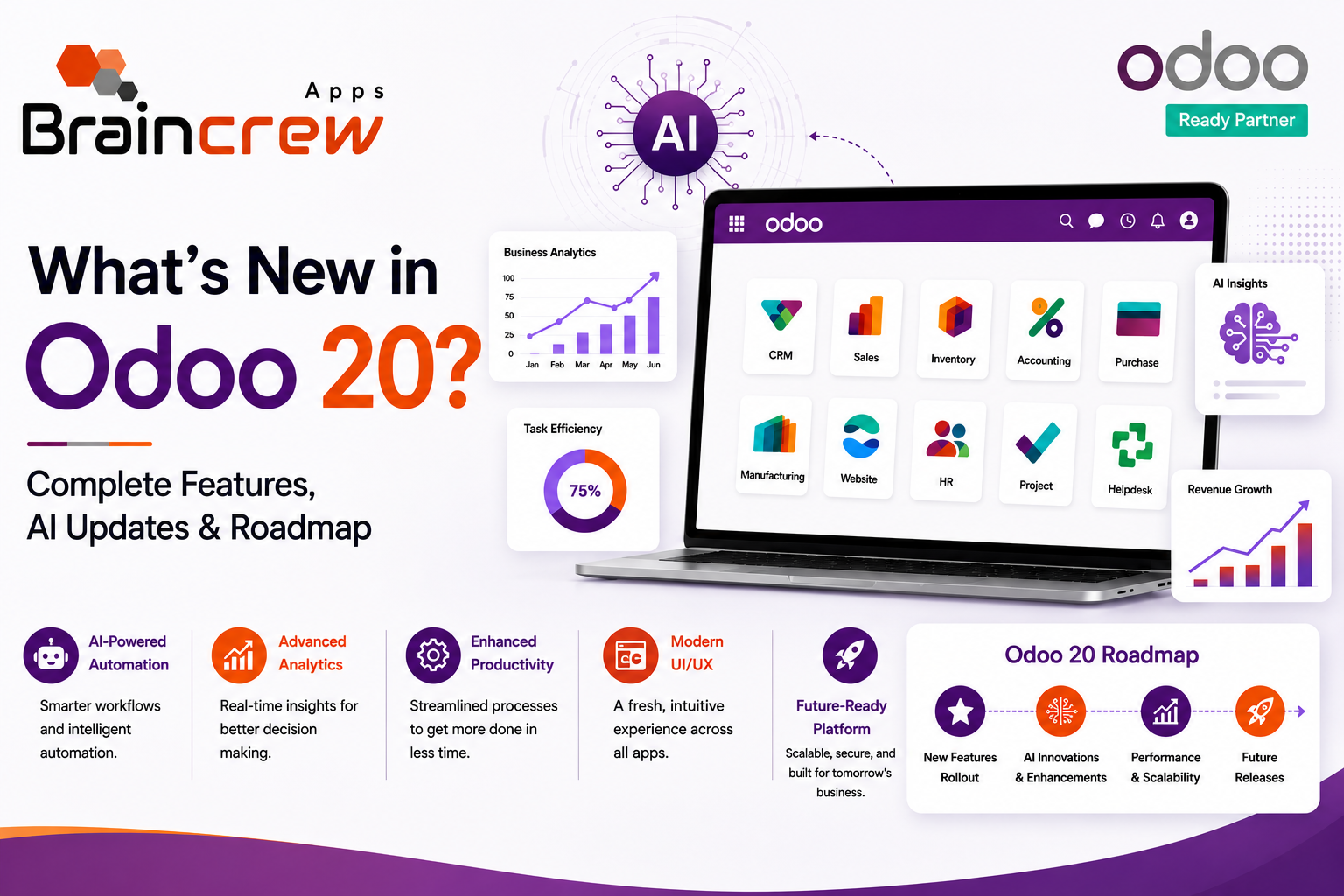
Although Odoo 20 has not been officially released at the time of writing, industry discussions and Odoo’s development direction indicate a strong focus on artificial intelligence (AI), workflow automation, user experience improvements, and enhanced business intelligence. These advancements are expected to help organizations simplify operations while improving productivity across finance, manufacturing, sales, inventory, HR, and customer relationship management.
This guide explores the expected Odoo 20 roadmap, AI innovations, likely feature enhancements, and how businesses can prepare for a successful upgrade.
Quick Answer
Odoo 20 is expected to introduce smarter AI-powered automation, enhanced reporting, faster performance, improved user experience, and stronger integration across business applications. Businesses planning digital transformation should begin evaluating their current ERP environment and prepare for future migration to maximize productivity and operational efficiency.
What Is Odoo 20?
Odoo 20 is expected to be the next major version of the Odoo ERP platform, continuing its mission of providing an integrated business management solution through modular applications.
Like previous releases, Odoo 20 is anticipated to improve existing modules while introducing intelligent automation that reduces manual work and enables faster business decisions.
Businesses already using Odoo will likely benefit from:
- Faster workflows
- Improved user interfaces
- Better reporting capabilities
- More AI-powered productivity tools
- Enhanced business automation
- Stronger security and performance
Rather than reinventing the platform, Odoo 20 is expected to refine existing functionality while making ERP systems more intelligent and easier to use.
Expected Odoo 20 Release Timeline
While the official launch date has not yet been confirmed, Odoo traditionally unveils its new major version during its annual global event, Odoo Experience, followed by broader availability shortly afterward.
A typical release cycle includes:
Phase | Expected Timeline |
Feature Development | Ongoing |
Beta & Community Testing | Before official launch |
Official Announcement | During Odoo Experience |
General Availability | Following the annual release |
Businesses planning ERP upgrades should begin evaluating custom modules, integrations, and migration requirements well before the official release.
Top AI Features Expected in Odoo 20
Artificial Intelligence is expected to become one of the most significant enhancements in Odoo 20. Rather than replacing users, AI will likely support employees by automating repetitive tasks, generating insights, and improving decision-making.
1. AI Content Generation
Businesses increasingly rely on AI to create professional communications.
Expected capabilities include:
- Email drafting
- Product descriptions
- Sales proposals
- Marketing content
- Customer responses
This could significantly reduce administrative workload while improving consistency across customer communications.
2.Intelligent Business Assistant
Future Odoo versions are expected to provide conversational assistance for everyday business activities.
Possible use cases include:
- Retrieving sales reports
- Finding customer records
- Creating quotations
- Generating purchase orders
- Answering operational questions
This type of AI assistance can help employees complete routine tasks more efficiently.
3.Smarter Business Analytics
Reporting is becoming increasingly predictive rather than reactive.
Expected improvements include:
- AI-generated dashboards
- Revenue forecasting
- Sales trend analysis
- Inventory predictions
- Customer behavior insights
These capabilities allow managers to make faster and more informed business decisions.
4. Automated Workflow Recommendations
Instead of simply automating predefined workflows, Odoo 20 may recommend process improvements based on system usage patterns.
Potential benefits include:
- Reduced approval delays
- Faster document processing
- Improved operational efficiency
- Better resource allocation
Module Enhancements Expected in Odoo 20
CRM
Customer relationship management continues to be a core strength of Odoo.
Expected improvements include:
- AI-assisted lead scoring
- Smarter opportunity tracking
- Automated follow-up reminders
- Improved customer activity timelines
Sales teams can focus more on closing opportunities rather than managing administrative tasks.
Sales Management
Sales processes are expected to become faster and more intelligent.
Potential enhancements include:
- Automated quotation generation
- Better pricing recommendations
- Improved subscription management
- Enhanced sales forecasting
These improvements help businesses shorten sales cycles and improve customer engagement.
Accounting
Accounting remains one of Odoo’s most widely used applications.
Expected updates include:
- Improved bank reconciliation
- Faster invoice processing
- AI-assisted expense categorization
- Enhanced financial dashboards
These features can reduce manual bookkeeping while improving financial visibility.
Inventory & Warehouse
Inventory management is likely to receive additional automation features.
Expected enhancements include:
- Smarter replenishment planning
- Improved barcode workflows
- Better warehouse visibility
- AI-supported inventory forecasting
Manufacturers and distributors may benefit from more accurate stock control and reduced inventory costs.
Manufacturing (MRP)
Manufacturing businesses continue to demand greater production efficiency.
Odoo 20 is expected to enhance:
- Production scheduling
- Capacity planning
- Quality control workflows
- Shop floor management
- Predictive maintenance support
These updates can help manufacturers reduce downtime while improving production planning.
Human Resources
HR modules are expected to become more employee-focused.
Possible improvements include:
- Smarter recruitment workflows
- AI-assisted resume screening
- Enhanced employee self-service
- Improved performance management
These capabilities simplify HR administration while improving employee experiences.
Website & eCommerce
Businesses increasingly expect ERP systems to integrate seamlessly with online sales.
Expected enhancements include:
- Faster website performance
- Better SEO capabilities
- Improved online checkout
- Enhanced customer experience
- Smarter content management
These updates support businesses seeking stronger digital commerce capabilities.
Odoo 20 vs Odoo 19: What Can Businesses Expect?
Although Odoo 20 has not yet been officially released, businesses can expect gradual improvements rather than a complete redesign. The focus is likely to remain on usability, automation, AI-assisted workflows, and performance enhancements.
Feature | Odoo 19 | Expected Odoo 20 |
Artificial Intelligence | Basic AI capabilities | More integrated AI assistance across modules |
User Interface | Modern UI | Further streamlined and intuitive experience |
Reporting | Interactive dashboards | Smarter analytics with predictive insights |
Automation | Workflow automation | AI-assisted workflow recommendations |
CRM | Lead management | AI-powered lead scoring and smarter follow-ups |
Manufacturing | Production planning | Enhanced planning and predictive maintenance |
Inventory | Automated replenishment | Intelligent inventory forecasting |
Website & eCommerce | Responsive builder | Faster performance and improved SEO tools |
Accounting | Digital accounting | AI-assisted categorization and reconciliation |
These expected enhancements aim to help businesses improve efficiency while reducing repetitive manual tasks.
Which Businesses Will Benefit Most From Odoo 20?
Odoo’s modular architecture makes it suitable for organizations across many industries. The anticipated improvements in Odoo 20 are expected to deliver value for businesses seeking greater automation and scalability.
Manufacturing
Manufacturers can benefit from:
- Better production planning
- Improved Bill of Materials (BoM) management
- Smarter inventory forecasting
- Enhanced quality control
- More efficient shop floor operations
Retail & Point of Sale
Retail businesses may gain:
- Faster POS performance
- Improved customer loyalty features
- Real-time stock synchronization
- Better omnichannel sales management
Wholesale & Distribution
Distribution companies can expect:
- Improved warehouse visibility
- Smarter procurement planning
- Automated inventory replenishment
- Better order tracking
Service Businesses
Professional service providers can improve:
- Project management
- Time tracking
- CRM workflows
- Customer communication
- Financial reporting
Should Your Business Upgrade to Odoo 20?
For many organizations, upgrading is about more than accessing new features. It is an opportunity to modernize business processes, strengthen security, and improve operational efficiency.
Consider upgrading if your business:
- Uses an older Odoo version.
- Relies heavily on manual processes.
- Needs better reporting and analytics.
- Plans to expand operations.
- Requires improved integrations.
- Wants to leverage AI-driven automation.
Businesses with significant customizations should first assess compatibility to ensure a smooth transition.
Odoo 20 Upgrade Checklist
Preparing early can simplify the migration process and reduce operational risks.
Before Upgrading
✔ Review your current Odoo version.
✔ Identify custom modules.
✔ Audit third-party integrations.
✔ Clean outdated or duplicate data.
✔ Create complete system backups.
✔ Define project goals.
✔ Plan user training.
✔ Schedule testing before deployment.
A structured migration plan minimizes downtime and ensures business continuity.
Common Migration Challenges
ERP upgrades can become complex without proper planning.
Common challenges include:
- Custom module compatibility
- Data migration issues
- Integration conflicts
- User adoption challenges
- Inadequate testing
- Business process changes
Working with an experienced implementation partner significantly reduces these risks and helps businesses maximize the value of their ERP investment.
Why Businesses Choose Braincrew Apps for Odoo Upgrades
A successful ERP upgrade requires technical expertise, business understanding, and careful project management.
At Braincrew Apps, our Odoo specialists help businesses:
- Assess upgrade readiness
- Plan migration strategies
- Perform secure database migration
- Upgrade custom modules
- Integrate third-party applications
- Test business workflows
- Train end users
- Provide post-upgrade support
Our goal is to ensure businesses transition smoothly to newer Odoo versions while minimizing disruption and maximizing long-term value.
Conclusion
At Braincrew Apps, we help businesses navigate every stage of the ERP journey—from implementation and customization to migration, optimization, and ongoing support. If you’re planning your next Odoo upgrade, our team can help you create a migration strategy that aligns with your business objectives.
FAQ
When is Odoo 20 expected to be released?
Odoo typically announces a new major version during its annual Odoo Experience event. While the official release date for Odoo 20 has not been confirmed, businesses can monitor Odoo’s official announcements for the latest roadmap and availability.
Will Odoo 20 include artificial intelligence features?
Yes, based on Odoo’s recent development direction, Odoo 20 is expected to expand AI capabilities, including intelligent content generation, workflow automation, predictive analytics, and smarter business assistance.
Should businesses upgrade immediately after Odoo 20 is released?
Not necessarily. Businesses should first evaluate custom modules, integrations, operational requirements, and compatibility. A planned migration with proper testing usually delivers a smoother and lower-risk upgrade.
Can custom Odoo modules be migrated to Odoo 20?
Most custom modules can be migrated, but they often require compatibility reviews and updates to work with the latest version. An experienced Odoo implementation partner can assess and adapt customizations during the migration process.